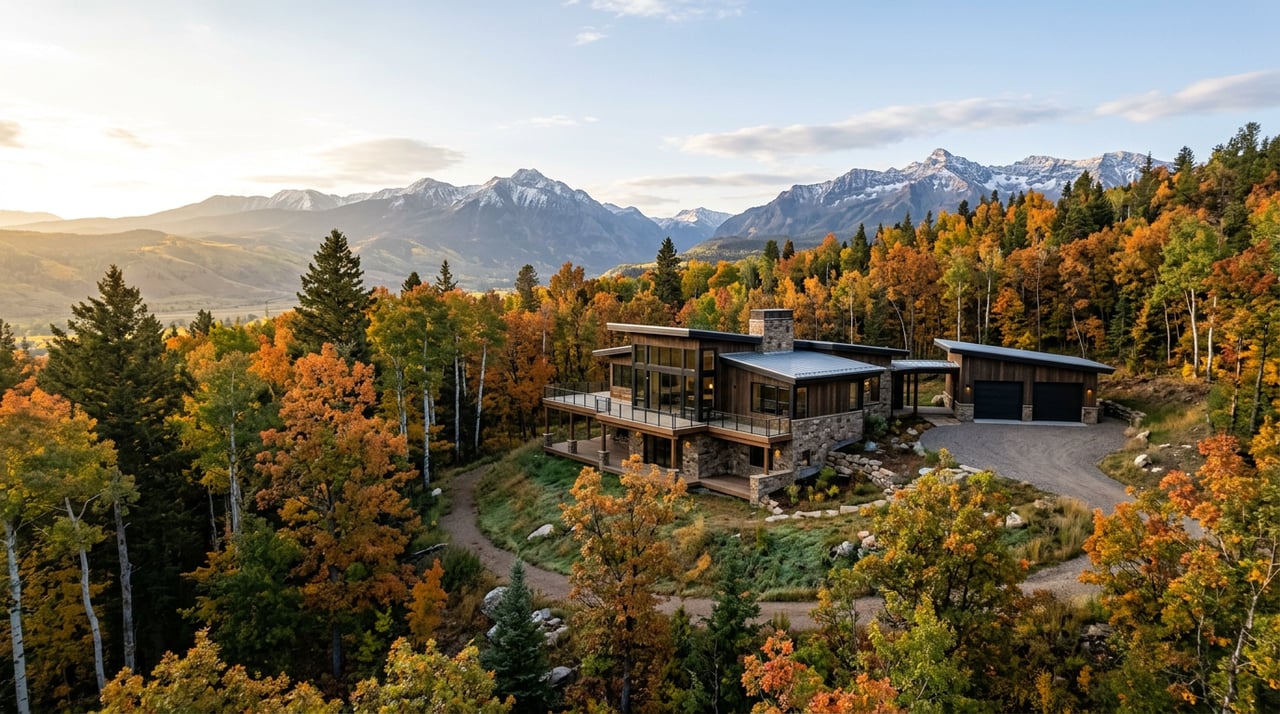
A buyer went under contract on a home in Evergreen this summer. Financing was clean. The appraisal came in at value. The inspection turned up nothing worse than a deck board that needed replacing. Then the file stalled anyway, because a wildfire burning two counties away had triggered a moratorium on new homeowners policies across the region, and not a single carrier, including the state's own insurer of last resort, would quote the address until the fire was contained.
That scenario played out near Colorado City during the Aspen Acres fire in early July 2026, not in Evergreen itself. But the mechanism behind it is not unique to one fire or one town. It is baked into how every carrier writing policies in Colorado's wildland-urban interface now operates, and Evergreen sits squarely inside that zone. If you are shopping here and pricing your purchase off the number on a listing page, you are missing the underwriter that actually decides whether the deal happens.
The freeze nobody puts on a listing sheet
Mortgage underwriting is slow and occasionally frustrating, but it is predictable. You know the documents it wants and the timeline it runs on. Insurance underwriting in a wildfire zone does not work that way. Carriers price and decline coverage using models that pull in satellite imagery, slope data, vegetation density, and distance to the nearest staffed fire station, and those models can change what they say about an address week to week, especially during active fire season. A property that would have been quoted in May can come back declined in July, not because anything on the parcel changed, but because the regional risk model moved.
This is why insurance has quietly become one of the things that can stall or kill a clean file in the final weeks before closing. Title professionals who work Front Range foothills closings describe insurance moving from a formality lenders check the week of closing to one of the top reasons a straightforward transaction turns messy. In flatland Denver suburbs, that usually means a buyer gets sticker shock on a quote. In Evergreen, it can mean no quote arrives at all until a live fire somewhere in the region burns out.
What $850,000 actually buys you in coverage
Run the numbers on a real Evergreen property profile and the gap gets concrete fast. When Colorado's FAIR Plan, the state's insurer of last resort, published its first rate examples after launching in spring 2025, it used a 2,288-square-foot Evergreen home valued at $850,000 as its illustration. Basic fire coverage on that home ran $4,361.69 a year. Add wind and hail, which most Colorado homeowners want given how much of the Front Range sits in hail alley, and the total climbed to $5,513.63 a year for the most basic tier of coverage available.
Here is the part that does not show up until you read the fine print: the FAIR Plan caps dwelling coverage at $750,000. That $850,000 home is under-covered by $100,000 by design, not by oversight. A legislative proposal to raise that cap to $1.5 million surfaced earlier this year, but reporting from as recently as this summer still cites the $750,000 ceiling as the operative number. If you are buying at or above that threshold and end up on the FAIR Plan because the private market declined you three times, you are carrying a structural coverage gap the day you close.
| Line item | Amount |
|---|---|
| Home market value | $850,000 |
| FAIR Plan dwelling cap | $750,000 |
| Coverage gap | $100,000 |
| Annual fire premium (FAIR Plan) | $4,361.69 |
| Annual wind/hail add-on | $1,151.94 |
| Total annual premium | $5,513.63 |
That total is roughly what a lot of Evergreen buyers would expect to pay in property taxes, except it recurs every year on top of them, and it assumes you even qualify for the FAIR Plan in the first place.
Why Jefferson County, specifically
None of this is random bad luck attached to one zip code. Jefferson County ranks first in Colorado for the number of homes sitting in high and extreme wildfire risk areas, according to the county's own citation of Verisk's ISO Stateline Report, and Evergreen is named alongside Conifer as one of the highest-risk areas within that ranking. More than two-thirds of the county falls inside a designated Wildfire Hazard Overlay District, which is the regulatory reason building permits, defensible space rules, and insurance underwriting all treat Evergreen addresses differently than a Lakewood cul-de-sac twenty minutes east.
The specific things that push an individual address into the high-risk bracket are mundane and mechanical: heavy timber close to the structure, a steep or single-access driveway, distance from a staffed fire station. Two homes on the same road can land on opposite sides of that line. One neighbor renews without a phone call. The other gets a non-renewal notice. Wildfire risk in a flatland Denver County zip code barely moves the premium at all, by some estimates accounting for around 1 percent of what a typical policy costs there. In the foothills, wildfire risk does not mainly show up as a slightly higher number on the declarations page.
It shows up as a carrier declining to quote you at all, regardless of what you're willing to pay.
That is the distinction a buyer comparing Evergreen to a suburban Front Range town needs to sit with. The conversation in Arvada is about price. The conversation in Evergreen is about whether coverage exists.
Two rules, one effective date
Two different pieces of wildfire policy took effect on the same day this summer, and the overlap is worth understanding because each governs a different part of your transaction. On July 1, 2026, Colorado's HB25-1182 became active statewide, requiring any insurer that uses a wildfire risk model to disclose that model, share your specific risk score in writing, and give you a formal path to appeal it if you think it is wrong. It does not force a carrier to insure you, and it does not cap what they can charge, but for the first time it gives homeowners the legal right to see the number driving their premium instead of guessing at it.
On that same date, Jefferson County's new Wildfire Resiliency Code went into effect for unincorporated properties inside the county's Wildland Urban Interface overlay. It sets defensible space and structure-hardening requirements tied to new construction and building permits, mapped against a Class 1 and Class 2 zone system the county finalized this spring. If you are buying land to build, or buying a home where a future addition or rebuild is part of the plan, this code determines what you can build and how, separate from whatever your insurance carrier requires.
One law governs the paperwork behind your premium. The other governs what your permit application has to include. Both matter to the same transaction, and both started applying to Evergreen properties within the last two months.
The lever you can actually pull
Mitigation work is not just a safety measure here. It is one of the only variables in this whole system that a buyer or seller has direct control over, and it is worth treating as a negotiating asset rather than an afterthought.
Evergreen Fire Rescue runs a defensible space grant that matches up to $5,000 in mitigation costs at 50 percent, funded specifically for homes inside the Evergreen Fire District. Qualifying starts with a free wildfire assessment from an EFR mitigation specialist, followed by quotes from a contractor on the department's approved list. Some Evergreen neighborhoods, including pockets around Brook Forest and Soda Creek, also participate in Firewise USA, the national recognition program that documents community-level fuel reduction work.
Before you write an offer on an Evergreen home:
- Get an insurance quote in hand before you waive your inspection contingency, not after
- Ask the seller for their current carrier name and premium history, the same way you would ask about a roof age
- Ask whether the property has had a recent EFR wildfire assessment or carries Firewise USA recognition, and ask to see the documentation
- Understand that FAIR Plan eligibility requires three documented declines from admitted carriers first, and that its coverage is actual cash value, not replacement cost
- Build fire season into your closing calendar, since a nearby active fire can pause new policy applications regardless of how strong your file otherwise is
None of this guarantees a lower premium. HB25-1182 gives you visibility into your risk score, not a promise that the score comes back low. But documented mitigation is the one thing insurers and lawmakers agree matters when a homeowner later appeals a rate or a decline, and it is the one thing you can start before you ever make an offer.
A market that is slowing at the edges
The listing-price data on Evergreen right now tells a mixed story on its own. Redfin's numbers for the three months ending June 2026 show a median sale price of $888,000, up about 1 percent year over year, while homes are taking 20 days to sell compared with 8 days over the same period last year. Zillow's typical home value estimate for the market, meanwhile, shows values down 4.7 percent over the past year. Different methodologies, different conclusions on direction, but both agree on the same underlying signal: the pace has changed. Homes that used to move in about a week now regularly take two to three times as long.
Some of that is ordinary rate sensitivity. Some of it, based on what title and insurance professionals are describing across the Front Range foothills this year, is buyers and lenders spending real time sorting out coverage before anyone will sign off on a closing date. A slower market is not automatically a weaker one. In Evergreen, it may just mean more of the real underwriting is happening off the closing statement, in an insurance file most buyers did not know they needed to open until their agent told them to.
A few questions that come up once buyers understand this
Does every home in Evergreen face this problem? No. Newer construction with Class A roofing, established defensible space, and easy road access still gets quoted by standard carriers. The risk concentrates on older homes with heavy surrounding timber, long or single-access driveways, and distance from a staffed station.
Will completing mitigation guarantee a lower premium? Not automatically. HB25-1182 requires insurers to factor mitigation into their pricing and share the reasoning, but a high wildfire risk score tied to your address's location and access can still keep you out of the standard market even with strong mitigation work documented.
Is the FAIR Plan cap actually going up to $1.5 million? A proposal to raise it has been discussed in the legislature this year, but as of the most recent reporting this summer, the $750,000 dwelling cap was still the operative limit. Treat any relief on that front as pending, not settled.
Insurance is not a footnote to buying in Evergreen. It is closer to a second loan approval, one that runs on its own timeline and its own logic. A local agent who tracks which carriers are still writing new policies here, which neighborhoods qualify for Firewise recognition, and how the FAIR Plan's rules actually apply can save you from finding any of this out during your own closing week. That is the kind of groundwork Closing Colorado does before you ever write an offer. Start Your Mountain Move with someone who already knows what your insurance file is going to ask of you.